

REVEALED : How ₦29 million Payment Routed Through Proxy Accounts ,Was Linked To CAC Registrar-General’s Inner Circle

Share this Post
Fresh documentary evidence has emerged raising serious concerns over the alleged diversion of public funds within the Corporate Affairs Commission (CAC), Nigeria’s corporate registry agency.

Documents reviewed by this newspaper — including payment vouchers, bank transaction records and electronic communications — indicate that ₦29,060,189.89 paid by the Commission to a private media consultancy was subsequently broken into tranches and transferred to third-party accounts allegedly linked to individuals with close personal ties to a senior public official.
The revelations have prompted calls from civil society and legal experts for a forensic investigation by anti-corruption agencies.
At the centre of the controversy is a payment of ₦29,060,189.89 made to Black Root Media Network Ltd.
Official records reviewed show the payment was processed under: Voucher Serial Number: 2193. Date: 7 August 2024. Source: Public funds of the Corporate Affairs Commission
The payment reportedly formed part of consultancy services rendered to the Commission.
However, the transaction had previously been flagged in a staff petition submitted to federal authorities, alleging financial impropriety, contract irregularities and abuse of office under the current leadership of the Commission.
While government agencies routinely engage consultants, the concern raised by investigators centres on what happened after the funds were disbursed.
Bank transaction records show that shortly after receipt of the funds, Black Root Media Network Ltd allegedly initiated a series of transfers in tranches of ₦5,000,000.
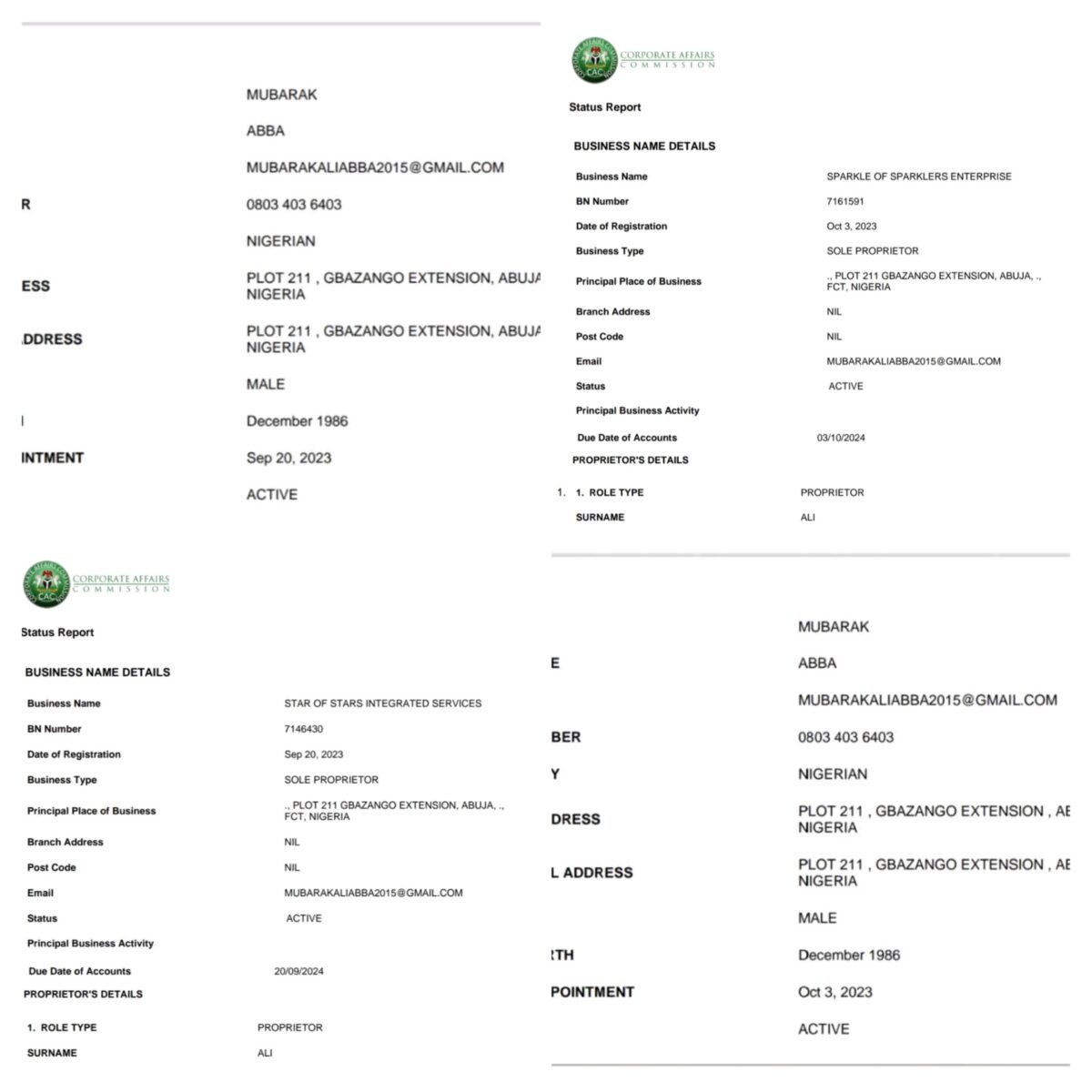
One beneficiary account identified in the documents is: Star of Stars Integrated Services, Account Number: 1304264619 and Bank: Unity Bank
Another transfer of similar value was reportedly made to: Sparkle of Sparklers Enterprise.
Financial crime experts consulted described the pattern — multiple high-value transfers in structured tranches shortly after receipt of public funds — as a recognised red flag in corruption and money-laundering investigations.
Under the Economic and Financial Crimes Commission (EFCC) compliance frameworks and global anti-money-laundering standards, rapid fragmentation of funds may indicate attempts to: Conceal beneficial ownership, Obscure audit trails, Facilitate indirect gratification, Avoid detection thresholds
A former compliance officer at a commercial bank, speaking on condition of anonymity, explained: “When you see immediate round-figure transfers in multiple tranches from a freshly credited public-sector payment, it triggers internal monitoring systems. It’s a classic layering typology.”
Independent corporate registry checks and internal sources suggest that the beneficiary entities may be linked to individuals with close personal or family relationships to a senior public officer.
If established, legal analysts say such arrangements could amount to violations under several statutes, including:
The Independent Corrupt Practices Commission (ICPC) Act.
The Code of Conduct for Public Officers; Public Service Rules; The Money Laundering (Prevention and Prohibition) Act.
A senior Abuja-based constitutional lawyer noted: “The use of proxy entities to receive indirect benefits from public contracts is a well-documented corruption typology. If beneficial ownership can be traced to a related party, that raises serious conflict-of-interest implications.”
Electronic messaging records reviewed by investigators appear to show direct instructions concerning the routing of funds to at least one of the beneficiary accounts.
In one communication, the sender allegedly directed that funds be transferred to a specified account associated with one of the entities.
Forensic accounting specialists say that when digital correspondence aligns with transaction timestamps and beneficiary records, it can help establish:
Knowledge and intent
Control over financial flows
Beneficial ownership links
Such findings, if substantiated, could trigger Suspicious Transaction Reports (STRs) under banking regulations and potential inquiries by regulators and law enforcement.
The emerging details appear to reinforce broader concerns raised in an earlier staff petition, which alleged: Contract inflation, Procurement irregularities, Abuse of office, Undeclared assets and Financial mismanagement.
Governance advocates argue that the issues extend beyond a single transaction and warrant a systemic audit of consultant engagements and procurement procedures at the Commission.
The CAC plays a central role in Nigeria’s business environment, overseeing company registration, regulatory compliance and corporate disclosures.
As Nigeria seeks to improve its investment climate, analysts warn that any perception of governance lapses within the Commission could have broader economic implications.
A public finance transparency advocate said: “Institutions responsible for corporate integrity must themselves be beyond reproach. Investor confidence depends on it.”
Civil society organisations and anti-corruption advocates are urging the following bodies to conduct a forensic review: the Economic and Financial Crimes Commission, the Independent Corrupt Practices Commission, the Code of Conduct Bureau and relevant National Assembly oversight committees.
They are calling for examination of:
Consultant engagements
Related-party transactions
Beneficial ownership structures
Asset declarations
Failure to investigate thoroughly, analysts say, risks undermining public trust in Nigeria’s corporate regulatory framework.
The Corporate Affairs Commission is central to: Corporate governance enforcement, Investor protection, Ease of doing business reforms and Transparency in business ownership.
Any substantiated evidence of conflict of interest or diversion of public funds could have significant implications for Nigeria’s reform agenda and international perception.